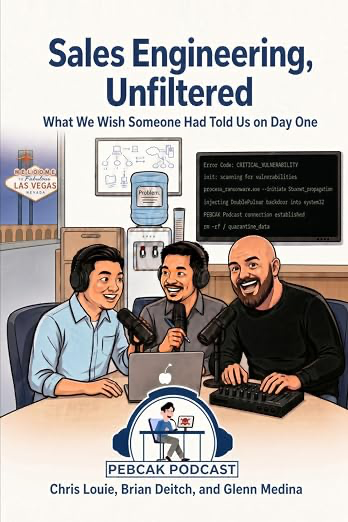
Sales Engineering, Unfiltered book cover

The Book

Sales Engineering, Unfiltered

What We Wish Someone Had Told Us on Day One

Nobody hands you a manual on day one as a sales engineer. So three guys who’ve spent their careers in the trenches wrote the one we wish we’d had. Not the training-deck version. The unfiltered one.

By Brian Deitch, Chris Louie, and Glenn Medina

The Premise

The job nobody trains you for.

Sales engineering is the strangest job in tech. You’re expected to be the smartest engineer in the room and the most trusted voice in the deal, at the same time, usually with about forty minutes of prep and a demo environment held together by hope.

Most of what makes a great SE gets passed down in hallway conversations, if it gets passed down at all. You learn it by watching demos go sideways, getting blindsided in a technical deep dive, and figuring out the politics of a deal the hard way. This book puts those hallway conversations on paper.

Why We Wrote It

The map we had to draw ourselves.

The SE role is one of the best jobs in tech when you know how to play it, and one of the fastest ways to burn out when you don’t. Every chapter comes from real scars, real wins, and real “why didn’t anyone tell me that?” moments.

It’s not a polished corporate handbook. We skipped the buzzwords and kept the stories raw. Every chapter ends with an action plan, because knowledge without application is just trivia.

And yes, it’s named after the podcast. PEBCAK: Problem Exists Between Chair And Keyboard. Every one of us has been that person, and the reminder that humility and curiosity beat ego is the whole point.

From the Book

Brian, unfiltered.

“Your career capital compounds faster than any 401k when you share what you know.”
Introduction
“If your entire career advantage disappears because someone else got your discovery template, congratulations, your moat was made of pudding.”
Giving Back
“Improvisation is preparation with the safety rails kicked off.”
Improvisation
“At the end of the day, I work for the Bank of Brian Deitch.”
Salary Negotiation
“There is a big difference between being a team player and being a human junk drawer.”
Learning to Say No
“AI is not replacing the SE. It is replacing the part of the SE job that made you question your life choices at 11:47 p.m.”
The Role of AI

Excerpt · Every Failure Is a Gift

The booking engine incident.

Early in my career, I was a systems engineer for an airline. My boss gave me one of the most valuable briefings I have ever received.

“If you f*** up, come tell me immediately. I do not care how bad it is. Come tell me and I can help you fix it. But if you try to cover it up, you will fail. It will create more problems, more damage, and eventually it will break something important. And here is the part you need to understand. All the data will be in the logs. I will find out who f***ed up, and I will, let me repeat this, I WILL throw you under the bus. So save yourself the trouble and just tell me when you f*** up.”

At the time, I thought it was just a funny, aggressive way to say, “Please communicate clearly.”

It was not. It was survival advice.

Not long after that, I was asked to remediate a vulnerability against the airline’s booking site. The issue was HTTP CONNECT. Basically, do not allow HTTP CONNECT to the booking engine.

Whatever. I got this.

Keep reading

I wrote an iRule, blocked it, tested it, fixed it, dropped the mic, and walked away like I had just personally saved aviation from cyber doom.

About thirty days later, we had a four-hour outage. The booking engine went offline.

Why? Because some dipshit decided it would be a great idea to log LOCAL every blocked HTTP CONNECT request.

That dipshit was me.

The logs crushed the system. The fix became the problem. I had taken a vulnerability remediation task, added a little “look how responsible I am” logging, and accidentally built a self-inflicted denial-of-service machine pointed directly at the booking engine.

That is a special kind of professional nausea. The kind where your stomach drops, your face gets hot, and your brain immediately starts opening tabs it should not open.

Maybe it was not me. Maybe something else changed. Maybe the system was already fragile. Maybe we should blame capacity planning, Mercury in retrograde, or the general sins of commercial air travel.

But the logs were there. The evidence was there. And the truth was there. I f***ed up.

That moment burned the lesson into me permanently. Failure is not theoretical when customers cannot book flights. It is not a leadership quote on LinkedIn with a sunset behind it. It is real. It has impact. It has cost. It has names attached to it. And sometimes one of those names is yours.

That policy from my boss rewired my nervous system. It turned shame into speed. I stopped wasting energy on spin and started using that energy on recovery. I stopped trying to protect my ego and started trying to protect the system.

And in sales engineering, that muscle matters. Because you are going to get it wrong. A demo will crash in front of the CIO. You will give an answer with full confidence and then realize later you were confidently driving the wrong car down the wrong freeway. You will tell a customer something works a certain way, then find out there is an asterisk the size of a Buick sitting in the documentation.

The clock starts the moment something goes wrong. Not when you feel emotionally ready. Not when you have crafted the perfect executive-safe paragraph. Not after you have quietly hoped the problem dies in a corner like a houseplant nobody watered.

The moment something breaks, you have a choice. Own it or hide it. Owning it feels bad for five minutes. Hiding it can poison the whole deal, the relationship, and your reputation.

The best move is almost always the same:

Here is what happened.Here is the impact.Here is what I know.Here is what I do not know yet.Here is what I am doing to fix it.Here is where I need help.

That is not weakness. That is professional adulthood.

What’s Inside

Every chapter ends with an action plan.

  1. What an SE actually does all day
  2. Interviewing like it's a customer meeting
  3. Your home office is your stage
  4. Building a personal brand you own
  5. Finding a real champion
  6. Every failure is a gift
  7. Ghostwriting email for executives
  8. Salary negotiation
  9. Improvisation and the zero-tech pitch
  10. Volunteering as a promotion hack
  11. Work-life balance and saying no
  12. Handling negative feedback
  13. Getting the most out of SKO
  14. The role of AI in an SE's life
  15. Finding your motivation
  16. Career moves from the SE seat
  17. Building a home lab
  18. Having a strong support system

Who It’s For

If you sell or support the sale.

New SEs

Skip a few years of painful lessons and the demo that goes sideways in front of the CIO.

Engineers eyeing the jump

What changes when your job becomes customers, quotas, and talking in front of rooms.

Seasoned SEs

Nod along, laugh at the scars you share with us, and steal a few ideas.

Sales leaders and AEs

Finally understand what your SE is actually thinking during that discovery call.

The Authors

Three voices. Three lenses.

Same mission: hand you the map we had to draw ourselves.

The Principal SE

Chris Louie

Two decades carrying a backpack full of laptops into cybersecurity, cloud, and AI deals. His sections are tactical: discovery questions, demo scripts, objection handling, and productivity hacks that saved him hundreds of hours.

chrislouie.net

The SE Manager

Glenn Medina

Built and scaled engineering teams from five to fifty after starting out as a non-commissioned officer in the military. He's hired, coached, and promoted SEs, and had the hard conversations too. His voice shows up on career moves and managing up.

The Evangelist

Brian Deitch

The 30,000-foot view: industry shifts, speaking on stage, influencing product roadmaps, and turning expertise into career capital that follows you from company to company.

Get It

Buy it, or let me send you one.

I’d rather this book end up with the people it was written for than sit on a shelf.

Get it on Amazon